The Research
How light, scent and sound shape a space.
Parlour's programmes are informed by established research into non-visual light exposure, olfaction, sound and autonomic response. What follows is the reading behind the design, and a short account of how it is used.
The premise
A room is not a neutral container. It is a continuous set of signals — brightness, spectrum, air, odour, tempo, reverberation — that the body reads before the mind describes them.
Hospitality has always understood this intuitively, and has largely left it to chance: a good room happens when a designer's instincts, a set of fittings and a time of day happen to agree. Parlour begins from the opposite position — that the three channels a guest actually perceives can be composed, held together on one timeline, and repeated exactly.
Light
Spectrum, intensity and timing are treated as design variables, not fittings.
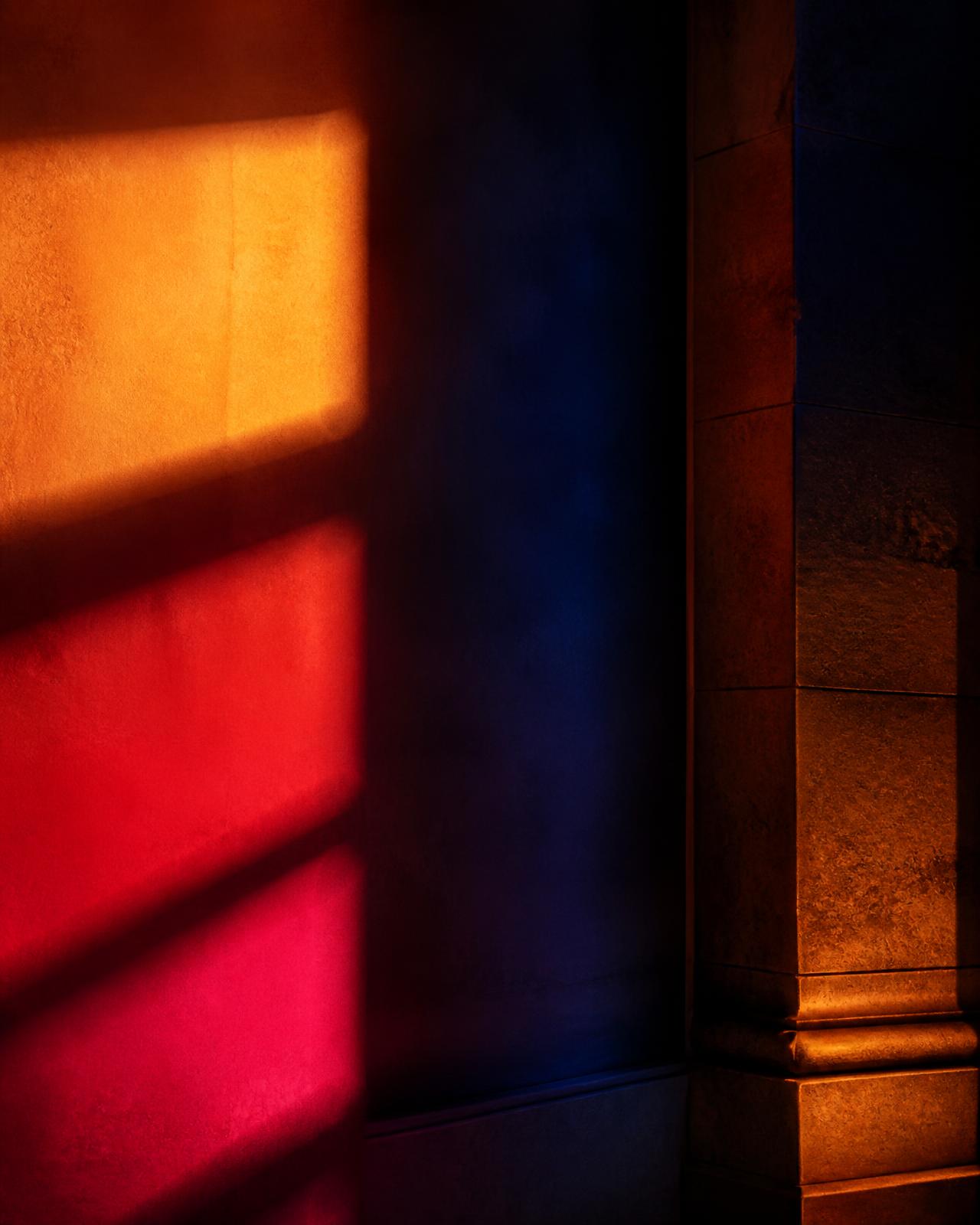
A room is read first as light. Beyond vision, a distinct class of retinal cells — most sensitive to short-wavelength blue — reports overall brightness to the brain regions that govern alertness, body temperature and the timing of sleep. The same lamp at the same lux can therefore feel entirely different depending on its spectrum and the hour it is used.
Parlour treats this as a compositional problem. Each state fixes a colour temperature, an intensity envelope and a rate of change, so light in the late evening withdraws into warmth and depth while a morning state opens cool and bright. Contrast, shadow and the direction of the wash matter as much as the colour: a room that is evenly lit reads as a corridor, a room lit from three considered positions reads as an interior.
Selected references
- Brown, T. M. et al. Recommendations for daytime, evening and night-time indoor light exposure to best support physiology, sleep, and wakefulness. PLOS Biology, 2022.
- Berson, D. M., Dunn, F. A., Takao, M. Phototransduction by retinal ganglion cells that set the circadian clock. Science, 2002.
- Vandewalle, G., Maquet, P., Dijk, D-J. Light as a modulator of cognitive brain function. Trends in Cognitive Sciences, 2009.
- Cajochen, C. Alerting effects of light. Sleep Medicine Reviews, 2007.
- Chellappa, S. L. et al. Non-visual effects of light on melatonin, alertness and cognitive performance. PLOS ONE, 2011.
- Lucas, R. J. et al. Measuring and using light in the melanopsin age. Trends in Neurosciences, 2014.
Scent
Fragrance is composed for memory and association, then dosed for a room rather than a product.

Olfaction reaches the brain by an unusually direct route, arriving at structures involved in emotion and memory before it is fully described in language. This is why a scent is often recognised as a feeling — a place, a season, a person — some moments before it is named, and why odour-evoked recollection carries more emotional weight than the same memory cued by an image.
The practical consequences are strict. Concentration is set so the fragrance is perceptible on entry and recedes within minutes as the nose adapts; the composition is built to decay cleanly rather than turn heavy; and each state pairs one accord to one intent, so guests learn the room's vocabulary instead of meeting a different perfume every visit. Diffusion is cold-air and cartridge-sealed, which keeps the material stable and the dose repeatable.
Selected references
- Herz, R. S. The role of odor-evoked memory in psychological and physiological health. Brain Sciences, 2016.
- Herz, R. S., Schooler, J. W. A naturalistic study of autobiographical memories evoked by olfactory and visual cues. American Journal of Psychology, 2002.
- Sowndhararajan, K., Kim, S. Influence of fragrances on human psychophysiological activity. Scientia Pharmaceutica, 2016.
- Hummel, T. et al. Perceptual and physiological responses to odours. Chemical Senses, 2017.
- Sobel, N. et al. Sniffing and smelling: separate subsystems in the human olfactory cortex. Nature, 1998.
Sound
Tempo, density and silence are choreographed against the light.
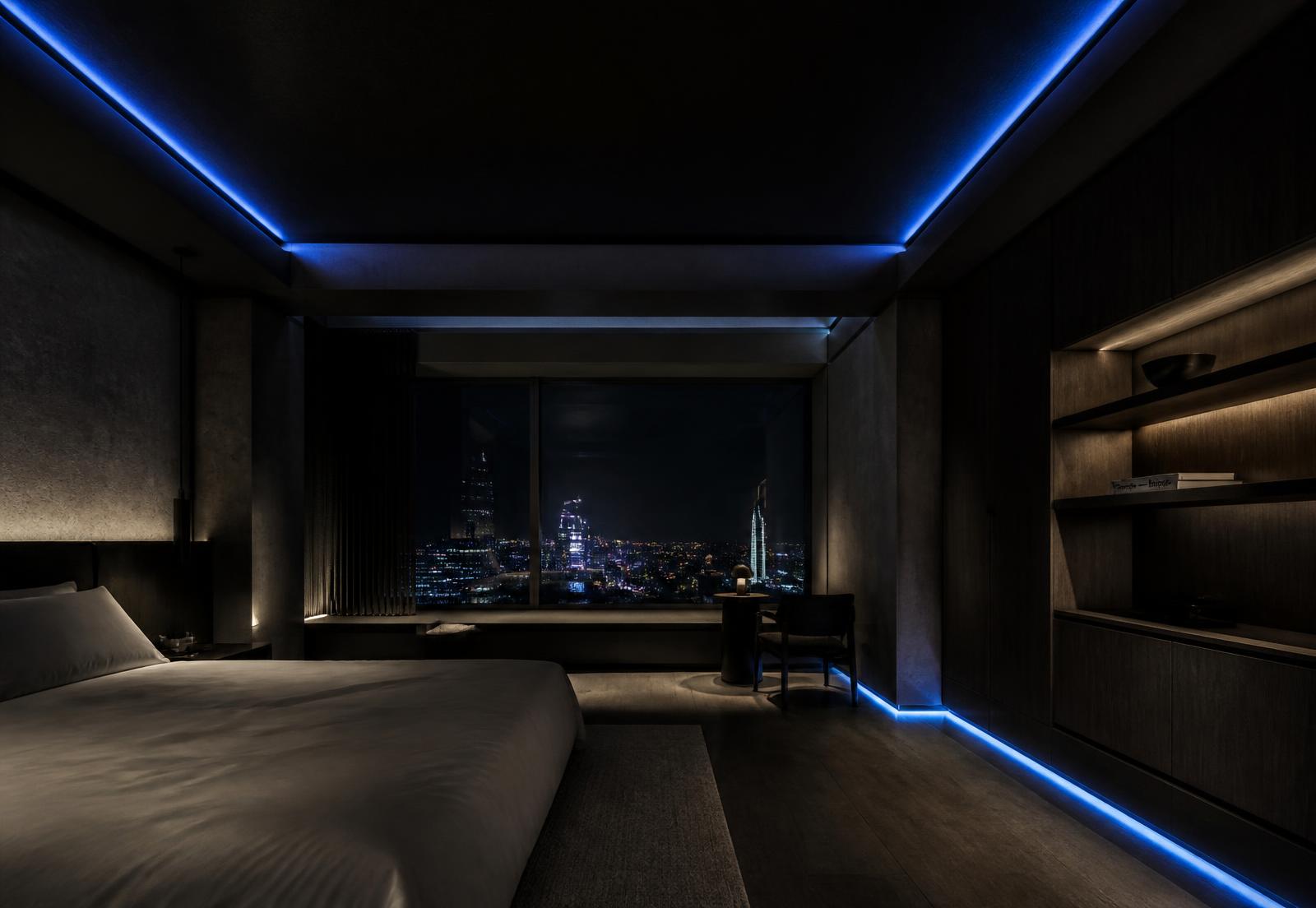
Sound sets the pace of a room. Slow tempi, low rhythmic density and predictable structure are associated with reduced arousal, while unpredictable or intrusive sound holds attention whether or not it is wanted. Much of the work in hospitality is subtractive: masking mechanical noise, softening reverberation and removing the incidental sounds that tell a guest they are in a building rather than a place.
Parlour composes original material to move with the light — never a playlist, never a loop with a visible seam — and treats silence as an instrument. In the deepest states the soundscape thins to almost nothing, because the room by then is doing the work, and anything added would be decoration.
Selected references
- Thoma, M. V. et al. The effect of music on the human stress response. PLOS ONE, 2013.
- Bernardi, L., Porta, C., Sleight, P. Cardiovascular, cerebrovascular and respiratory changes induced by different types of music in musicians and non-musicians: the importance of silence. Heart, 2006.
- Koelsch, S. Brain correlates of music-evoked emotions. Nature Reviews Neuroscience, 2014.
- Basner, M. et al. Auditory and non-auditory effects of noise on health. The Lancet, 2014.
- Trappe, H-J. The effects of music on the cardiovascular system and cardiovascular health. Heart, 2010.
Environment & Autonomic Response
The room is read as a single multisensory object, not three systems in one ceiling.

The senses are not evaluated independently. Research in multisensory design shows that congruent inputs — warm light with a warm accord, slow sound with slow dimming — are judged more coherent and more pleasant than the same elements presented out of step, while incongruent combinations produce a low-grade unease that guests rarely attribute to any single cause.
This is the argument for choreography over control. Parlour holds the three channels on one timeline so that a state arrives, settles and releases as one gesture. It is also the reason the system is deliberately restrained: the measurable effects described in this literature are modest, context-dependent and studied under conditions that are not a hotel suite. The work treats them as design intelligence, not as a promise.
Selected references
- Ulrich, R. S. et al. Stress recovery during exposure to natural and urban environments. Journal of Environmental Psychology, 1991.
- Spence, C. Senses of place: architectural design for the multisensory mind. Cognitive Research: Principles and Implications, 2020.
- Spence, C. Crossmodal correspondences: a tutorial review. Attention, Perception & Psychophysics, 2011.
- Malkin, R. et al. The influence of the environment on comfort and restoration in indoor settings. Building and Environment, 2019.
- Ulrich, R. S. et al. A review of the research literature on evidence-based healthcare design. HERD, 2008.

How it is used
Each state begins as a written intent — a way a guest should feel on entering and on leaving. The literature narrows the options: it tells us which direction to move colour temperature at nine in the evening, how long a fragrance should be perceptible, where a soundscape should stop. Everything after that is design judgement, tested in a working spa on real guests, and revised until the room is right.
The research informs the design of each environment. Parlour does not position these individual studies as clinical validation of the complete system, and makes no medical claims.
Parlour · Notting Hill, London